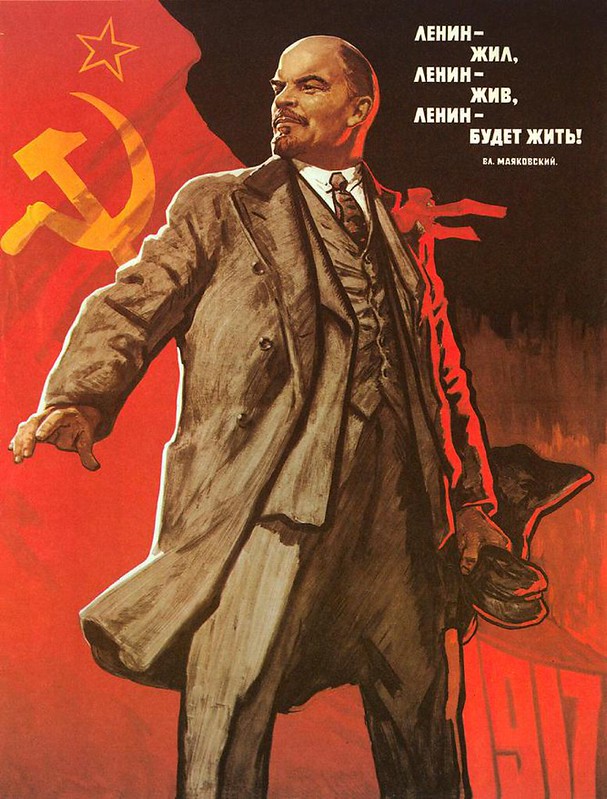
“The question is: what means other than war could there be under capitalism to overcome the disparity between the development of productive forces and the accumulation of capital on the one side, and the division of colonies and spheres of influence for finance capital on the other?”
—V.I. Lenin, Imperialism
The sanctions on Russia for its invasion of Ukraine have demonstrated two aspects of the contemporary imperialist order: (1) the enormous destructive power of finance capital and (2) the deepening shift in global capitalism away from a relatively peaceful transactional economy to a regionally-segmented array of power blocs whose primary governing mechanism is force. This is not to say that force has heretofore been absent, but that it will become an increasingly dominant feature of geopolitics.
In temporary periods of peace, finance capital is able to cohere relatively “free” markets and an ideological vision of an integrated, liberal, global capitalist order. Long- and short-term financing can take place across national borders, which tends to push the system toward an equalization of profit rates as capital is able to take advantage of global opportunities for arbitrage. The markets for Treasury securities, Eurodollars and Petrodollars are all results of and facilitate integrated global finance and buttress ideological faith in globalization.
These markets all have their roots in the overwhelming dominance of U.S. imperialism after World War II, which established the dollar/gold standard at Bretton Woods. The mid-1970s deal between the U.S. and Saudi Arabia to ensure that the latter would only sell oil in dollars in exchange for technology transfer, further entrenched the dollar standard by giving rise to the Petrodollar system wherein most oil transactions have been done in dollars. Due to the centrality of demand for oil in the global economy, the Petrodollar regime has ensured a continued demand for dollars as the U.S. manufacturing sector has declined.
From the second half of the twentieth century, the market for dollars, i.e. where dollars have been invested, created, bought and sold, has centered on the Treasury security and Eurodollar markets. Treasuries are seen as the most stable and liquid means of storing dollar reserves and as pristine collateral for financing. As global transactions lead to the accumulation of dollars by nations and corporations, those dollars are often lent to the U.S. government as Treasuries, which finances the U.S. military and other government programs. The Eurodollar market, the deepest and most liquid market for dollars in the world, also allows economic entities to recycle dollar reserves.
The key feature of these three markets is their international character. Participants including the U.S., China, Russia, Germany, England, etc. transact in these markets with relatively little concern for how the dollars they invest will be spent as long as they can earn a return on and of capital.
That system started to break down in 2007 and is now shattering with the reassertion of imperialist geopolitics.
The sanctions imposed on Russia number in the thousands, including those on individual politicians and oligarchs, state-owned and private companies and banks. But the most significant sanction is the freezing of the dollar reserves of the Russian Central Bank: “Within a fateful 24 hours, the Russian central bank and Russians lost access to 60 per cent of FX reserves, $388bn out of a total $643bn. They lost access to entire arrays of assets: securities and deposits in western central banks ($285bn) and in western commercial banks and brokerages ($103bn). The Russian central bank is left with $135bn worth of gold in its vaults, $84bn of Chinese securities denominated in renminbi, a $5bn position in the IMF and a residual $30bn in actual cash, dollars and euros.” (Financial Times, 3 March 2022)
This has been a devastating blow to the Russian economy—causing bank runs across the country, ensuring a massive drop in economic output and provoking a possible default by Russia on its debts—which will have untold consequences on the Russian working class.
But the implications of this move for geopolitics are profound: it sets the precedent that the imperialists will confiscate dollar reserves when subordinate countries step out of line. In other words: “You may own those dollars but because they are held on our digital ledger, you cannot access them.” Russian foreign minister Sergey Lavrov summed it up in one word: “thievery.” While, in many respects, the imperialist sanctions imposed on Russia for its invasion of Ukraine are not qualitatively different from those imposed on Iran for its nuclear program, quantity has now turned into quality. The scale of this siege of the Russian economy has shown that the imperialists are preparing to dispense with the remnants of the transaction-based, liberal, global capitalist order.
This transition is similar to that which occurred before World War I, when Lenin wrote his polemic against Kautsky’s idea that finance capital had achieved a state of “ultra-imperialism, i.e., of superimperialism, of a union of the imperialisms of the whole world and not struggles among them, a phase when wars shall cease under capitalism, a phase of ‘the joint exploitation of the world by internationally united finance capital.’” This is what the proponents of liberal globalization aspired to in the twenty-first century, but peace under capitalism is always temporary. The contradictions of capitalism have returned drenched in blood. Lenin continues, “Kautsky’s utterly meaningless talk about ultra-imperialism encourages, among other things, that profoundly mistaken idea which only brings grist to the mill of the apologists of imperialism, i.e., that the rule of finance capital lessens the unevenness and contradictions inherent in the world economy, whereas in reality it increases them.” Lenin’s analysis, which has been proven correct for at least the second time, points to the savagery that is inherent to capitalism in its highest stage: imperialism.
Where global capitalism heads from here is unclear, but we may be seeing the beginning of a new cycle of state capitalism wherein nation-states attempt to build autarkic economies, reshoring production and supply chains, in order to ensure national security. National autarky could provide two benefits to national ruling classes: (1) key military materials could be made available to build up a nation’s military presence and increase the likelihood of victory in a largescale war and (2) nations could decrease reliance on other national economies that may take non-transactional/force-based action against them. This would likely lead to an attempt by the imperialists to redivide the world using force as opposed to transactions. As Lenin states, the redivision of the world will be an attempt to resolve the contradictions between the level of imperialist nations’ productive forces and their corresponding spheres of influence. One of the main contradictions is that between the persistence of the dollar standard and U.S. imperialism’s military hegemony on the one hand and the decline in the level of American industry on the other.
How this will play out is impossible to predict, but some very practical questions will likely arise. For nations subject to the dollar standard, is it safe to continue holding substantial dollar reserves when they can be confiscated by the imperialists at any time? Should India and Russia consider adopting the Chinese Yuan for at least some portion of trade? Should China continue to buy treasuries, financing the U.S. military and government spending? Should EU countries continue to pay Russia for energy, financing Putin’s invasion of the imperialists’ sphere of influence in eastern Europe? And of course, today, Putin has announced that Russia will demand payment for energy in Rubles instead of dollars or Euros, a defensive move to prop up the Ruble in the face of the imperialist siege.
These questions will increasingly be answered based on the prerogatives of national security instead of pure profit.
 World of Lenidzky