Reading: Capital III, ch. 21-26 For Marx, interest-bearing capital is a special form of capital. It has the peculiar quality, much like labor-power, that the consumption of its use-value is productive of surplus-value. This is the basis of interest in the capitalist system. Interest is simply the price paid for capital that can produce surplus-value. […]
Author: Lenidzky
Capital Volume II: Class 5
Reading: Capital III, ch. 16-20 Having described in Volume II the full circuit of capital from production through circulation and back to production, in Volume III Marx extends his analysis to the class structure of these different phases of capital’s movement. He lays out his dialectical view of this class structure in the following way: […]
Capital Volume II: Class 4
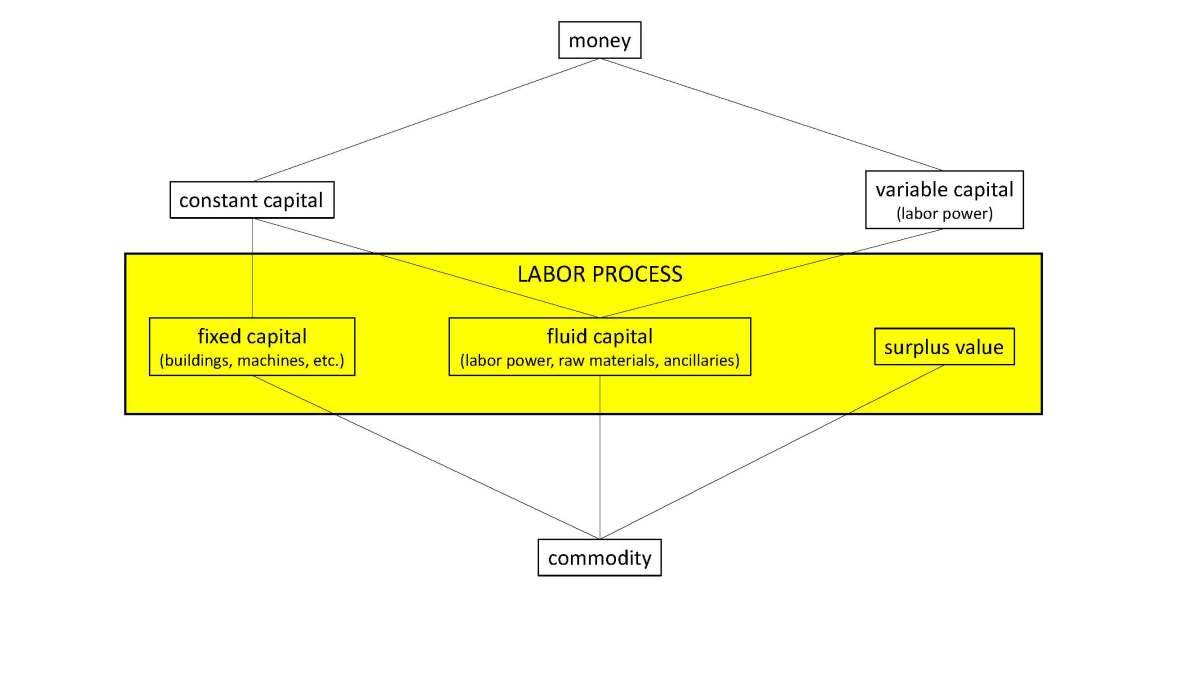
Reading: Capital II, ch. 7-11 Part II, The Turnover of Capital, begins with a description of fixed and fluid capital. These are the two forms of capital found in productive capital. To review, productive capital is one of the three forms capital takes as it moves through the economy. Productive capital is that capital found […]
Capital Volume II: Class 3
Readings: Capital II, ch. 4-6 Chapters 4-6 do not entirely hold together and there are key points made in each, so I will separate this out into a few sections. First, chapter 4 contains an important theoretical formulation that fills out some of the scattered theoretical references made in Volume I. What is Marx’s theory […]
Capital Volume II: Class 2
Readings: Capital II, ch. 1-3 At the start of Volume II, Marx introduces the process of circulation of industrial capital, which he divides into three forms: money capital, productive capital and commodity capital. Since this is the first time I am reading this text, I do not know exactly where he is going with this, […]
Bitcoin has acted as an index of uncertainty since its inception. It was born out of the financial crisis of 2007-09 with a message embedded in the genesis block referencing the instability of the financial system: “The Times 03/Jan/2009 Chancellor on brink of second bailout for banks.” As the financial systems of the imperialist countries […]
Capital Volume I: Class 12
The section on so-called primitive accumulation (I do not know why it is “so-called”) is Marx’s most historical exposition in Volume I. It traces the period from approximately the 16th century to the early 19th century, which encapsulates the emergence of capitalism in England. As usual, Marx’s history is polemical—his primary focus is to smash […]
Capital Volume I: Class 11
Readings: Capital I, ch. 25; Capital III, ch. 5, 6, 13-15 “Finally, the law which always holds the relative surplus population or industrial reserve army in equilibrium with the extent and energy of accumulation rivets the worker to capital more firmly than the wedges of Hephaestus held Prometheus to the rock. It makes an accumulation […]
Capital Volume 1: Class 10
Readings: Capital I, ch. 23, 24 In these chapters, Marx lays out the concepts of reproduction and accumulation. It is helpful to read them together because the two processes are deeply related, or perhaps two sides of the same phenomenon. Reproduction refers to how the capitalist system is sustained. Accumulation refers to the way in […]
Capital Volume I: Class 9.67
Readings: Capital III, ch. 16, 21, 23, 27, 48, 49, 51; Capital II, ch. 6 This is a bit of divergence from Volume I, but just for one post. In this series of sections, Marx lays out several aspects of the circulation and distribution process of capitalist production. The two that are most salient here […]