
In David Harvey’s early work The Limits to Capital, he develops the foundations of his spatial analysis of capitalism through a reading of all three volumes of Karl Marx’s Capital. This post focuses on the sections devoted to the centralization of capital and finance capital. While Harvey provides a series of insightful analyses regarding the […]
Category: Marx’s Capital
Categories
Capital Volume II: Class 11
Readings: Capital II, ch. 20 (sections 6-13), 21 Returning to a point I have made multiple times, the implication of Marx’s theory in Capital is that the anarchic capitalist system needs to be replaced with an egalitarian, planned economy. His project is to render visible all of the hidden and ignored inefficiencies in capitalism so […]
Categories
Capital Volume II: Class 10
Readings: Capital II, ch. 18, 19, 20 (sections 1-5) Part Three of Volume II develops in greater detail the concept of reproduction, originally introduced in Volume I. In my notes on Volume I, I wrote that reproduction refers to how the capitalist system is sustained. In this section of Volume II, Marx delves into exactly […]
Categories
Capital Volume II: Class 9
Readings: Capital II, ch. 15-17 “If we were to consider a communist society in place of a capitalist one, then money capital would immediately be done away with, and so too the disguises that transactions acquire through it. The matter would be simply reduced to the fact that the society must reckon in advance how […]
Categories
Capital Volume II: Class 8
Readings: Capital II, ch. 12-14 The total turnover time of capital is equal to the sum of the production time and the circulation time. Production time can be further broken down into the working period and the period of production during which no labor is done. During the non-working period, constant capital undergoes natural processes […]
Categories
Capital Volume II: Class 7
Readings: Capital III, ch. 36, 27-32 I have yet to find a place in Volume III where Marx explicitly defines fictitious capital. This may be a result of the unfinished nature of Part Five of this volume, or an oversight on my part. The closest I have found is his reference to fictitious capital as […]
Categories
Capital Volume II: Class 6
Reading: Capital III, ch. 21-26 For Marx, interest-bearing capital is a special form of capital. It has the peculiar quality, much like labor-power, that the consumption of its use-value is productive of surplus-value. This is the basis of interest in the capitalist system. Interest is simply the price paid for capital that can produce surplus-value. […]
Categories
Capital Volume II: Class 5
Reading: Capital III, ch. 16-20 Having described in Volume II the full circuit of capital from production through circulation and back to production, in Volume III Marx extends his analysis to the class structure of these different phases of capital’s movement. He lays out his dialectical view of this class structure in the following way: […]
Categories
Capital Volume II: Class 4
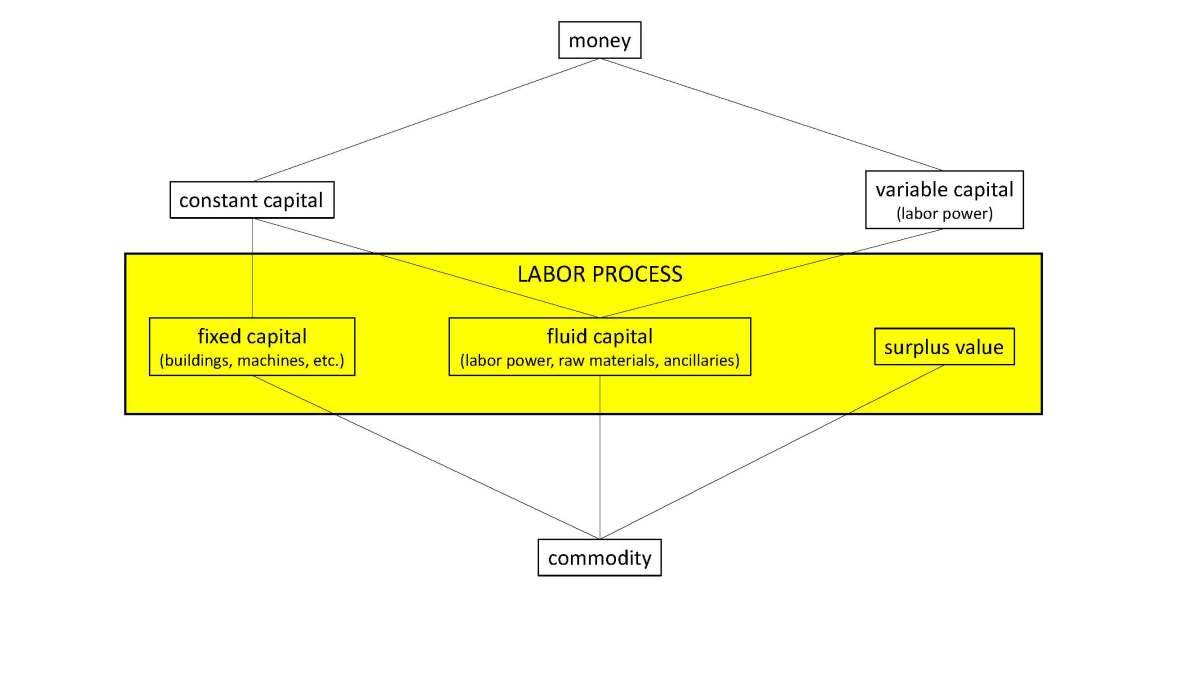
Reading: Capital II, ch. 7-11 Part II, The Turnover of Capital, begins with a description of fixed and fluid capital. These are the two forms of capital found in productive capital. To review, productive capital is one of the three forms capital takes as it moves through the economy. Productive capital is that capital found […]
Categories
Capital Volume II: Class 3
Readings: Capital II, ch. 4-6 Chapters 4-6 do not entirely hold together and there are key points made in each, so I will separate this out into a few sections. First, chapter 4 contains an important theoretical formulation that fills out some of the scattered theoretical references made in Volume I. What is Marx’s theory […]
 World of Lenidzky